

Love Marriage or Arranged Marriage? A Psychologist Explains
In today’s fast-paced world, stress, emotional imbalance, and mental fatigue have become increasingly common. While most of us pay attention to physical health, the subtle energy imbalances within the body often go unnoticed — yet they quietly shape our mood, clarity, relationships, and overall well-being.
Key Takeaways
- Both love and arranged marriages can succeed — what matters is compatibility, communication and mutual respect, not how you met.
- Love marriages start with emotional connection; arranged marriages often build it over time with family support.
- Challenges exist in both; counselling helps couples navigate them.
- MBS Holistic Clinic offers couples counselling in Kudasan, Gandhinagar.
This is where pranic healing comes in: a powerful, no-touch energy healing system that focuses on cleansing and balancing the body’s energy centers — the chakras. In this guide, you’ll learn how pranic healing works, what the chakras are, and a detailed look at each of the 11 major chakras in pranic healing, including the spleen, meng mein, navel, basic, and crown chakras.
What Is Pranic Healing?
If you’ve ever wondered what pranic healing is and how it works, it is a form of energy healing that uses “prana,” or life force, to restore balance in the body. Developed and popularized by Grand Master Choa Kok Sui, pranic healing is based on the principle that the body has an innate ability to heal itself when its energy field is properly maintained.
Unlike many traditional therapies, pranic healing does not involve physical touch. Instead, the practitioner works on the body’s energy field, or aura, to remove blockages and replenish it with fresh, clean energy. The entire focus of a session is on cleansing and energizing the chakras so that prana can flow freely.
Understanding Chakras and Energy Flow
Chakras are energy centers within the body that regulate physical, emotional, and mental processes. Each chakra absorbs, distributes, and processes prana for specific organs and parts of the body. When a chakra is blocked, depleted, or overactive, it can lead to physical discomfort, emotional stress, or mental fog.
This is why chakra cleansing and energy healing sit at the very heart of pranic healing. By keeping the chakras clean and balanced, the body’s natural self-repair mechanisms are supported, and overall vitality improves.
How Many Chakras Are There in Pranic Healing?
While popular yoga traditions usually describe 7 chakras, pranic healing works with 11 major chakras. Grand Master Choa Kok Sui’s system includes additional energy centers — most notably the spleen chakra and the meng mein chakra — that play a critical role in energy distribution and the regulation of vital organs.
Understanding all 11 chakras gives a far more complete picture of how energy moves through the body and why pranic healing can address such a wide range of physical and emotional concerns.
The 11 Major Chakras in Pranic Healing
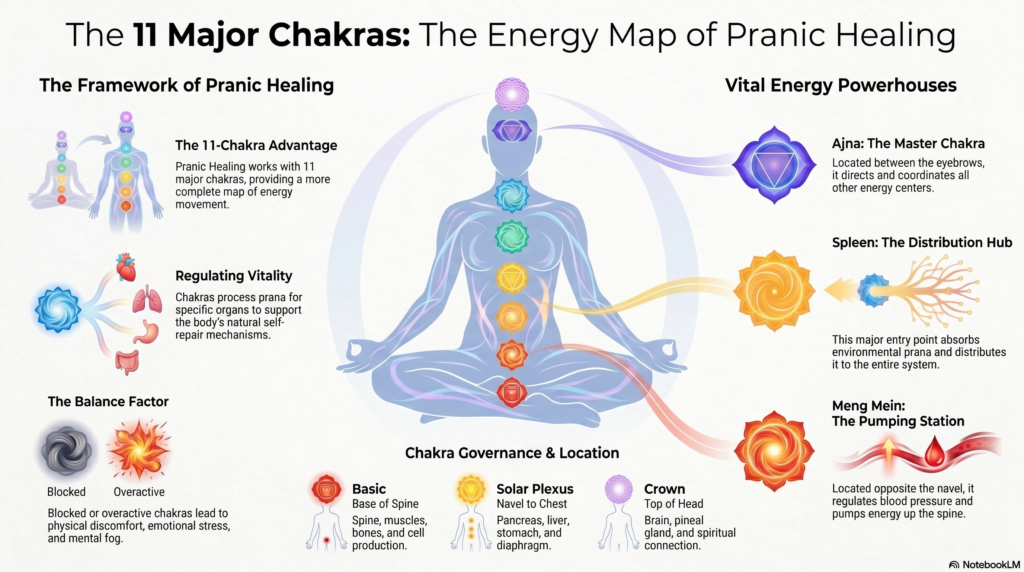
Below is a detailed look at each of the major chakras used in pranic healing, where it is located, and what it governs.
1. Basic Chakra
Located at the base of the spine, the basic chakra in pranic healing governs physical vitality, strength, and the overall energy level of the body. It controls the spine, muscles, bones, and the production of fresh, healthy cells. A clean, energized basic chakra is associated with good physical health, stamina, and a strong sense of security.
2. Sex Chakra
Situated near the pubic area, the sex chakra controls the sexual organs, bladder, and legs. It works closely with the throat chakra and influences creative and reproductive energy. Balancing this chakra supports healthy physical function and emotional creativity.
3. Meng Mein Chakra
The meng mein chakra is located at the back of the body, opposite the navel. It is one of the chakras unique to pranic healing and acts as a “pumping station” that regulates the flow of subtle energy up the spine. The meng mein chakra in pranic healing is closely associated with blood pressure and the proper functioning of the kidneys and adrenal glands. Because it is a powerful control center, it is handled with great care during a session.
4. Navel Chakra
Located at the navel, this chakra influences overall vitality, the small and large intestines, and the body’s general energy reserves. A balanced navel chakra in pranic healing supports good digestion, instinctive judgment, and a steady supply of usable energy throughout the body.
5. Spleen Chakra
The spleen chakra is one of the most important energy centers in pranic healing. Located on the left side of the body near the spleen, it acts as a major entry point for prana from the surroundings, then distributes that energy to the other chakras. Because of its role in energizing the whole system, the spleen chakra in pranic healing is treated as a key distribution hub — keeping it clean and balanced helps maintain strong overall vitality and a healthy immune response.
6. Solar Plexus Chakra
Found in the area between the navel and the chest, the solar plexus chakra in pranic healing is the seat of higher and lower emotions and a major energy center for the body. It controls the pancreas, liver, stomach, diaphragm, and large intestine. Balancing this chakra promotes confidence, emotional stability, and the ability to manage stress.
7. Heart Chakra
The heart chakra in pranic healing is located at the center of the chest and controls the heart, lungs, thymus gland, and circulatory system. Energetically, it influences peace, compassion, joy, and the quality of our relationships. A balanced heart chakra is essential for emotional warmth and inner calm.
8. Throat Chakra
Located at the center of the throat, this chakra governs the thyroid and parathyroid glands, the throat, and the lymphatic system. It is connected to communication, self-expression, and creativity. Cleansing the throat chakra supports clearer expression and healthy functioning of the throat and related glands.
9. Ajna Chakra (Brow Chakra)
The ajna chakra in pranic healing is located between the eyebrows and is often called the “master chakra” because it directs and coordinates the other chakras. It controls the pituitary gland and the nervous system, and is associated with willpower, discipline, and clarity of intention.
10. Forehead Chakra
Located at the center of the forehead, this chakra governs the pineal gland and the nervous system. It is associated with higher awareness, memory, and the ability to perceive subtle energy. Together with the back-of-head area, it plays an important role in mental clarity.
11. Crown Chakra
The crown chakra in pranic healing sits at the top of the head and is considered the entry point for divine, refined energy. It controls the pineal gland and the brain, and is linked to mental clarity, awareness, and spiritual connection. The back-of-head region is energetically associated with the crown and forehead chakras, and is often addressed to support calmness and mental focus.
The perineum or basic region anchors the body’s energy, while the upper chakras refine it — together, all 11 chakras form a complete energy map that pranic healing practitioners work with during every session.
How Pranic Healing Cleanses the Chakras
One of the key aspects of pranic healing for chakra cleansing is removing stagnant, used-up, or negative energy from the body. During a session, the practitioner:
- Scans the energy field to detect imbalances across the chakras
- Removes blocked, congested, or diseased energy
- Cleanses the affected chakras one by one
This process helps release emotional stress, mental fatigue, and energetic blockages. People searching for how to clean chakras naturally often find pranic healing to be one of the safest and most effective methods, because it works gently with the body’s own energy system.
How Pranic Healing Balances the Chakras
Once the chakras are cleansed, the next step is energizing them with fresh prana so that energy flows smoothly throughout the body. Here is how Pranic Healing balances the chakras:
- Restores proper, steady energy flow between chakras
- Strengthens weak or depleted chakras
- Stabilizes overactive energy centers
This balance creates a noticeable sense of calm, clarity, and emotional stability, often felt soon after a session.
Benefits of Pranic Healing for Mind and Body
The growing popularity of pranic healing benefits for the mind and body comes from its holistic impact on overall well-being.
Reduces Stress and Anxiety
By clearing congested energy, pranic healing helps calm the mind and release built-up emotional tension.
Improves Emotional Stability
Balancing the solar plexus and heart chakras helps regulate emotions and promotes inner peace.
Enhances Mental Clarity
A balanced crown, forehead, and ajna chakra supports better focus, memory, and decision-making.
Supports Physical Healing
When energy is aligned and the relevant chakras are strong, the body’s natural healing processes are better supported.
Boosts Overall Well-being
Regular sessions help maintain clean, balanced chakras, improving both mental and physical health over time.
What to Expect in a Pranic Healing Session
If you’re new to energy healing, you might wonder what actually happens during a session. Typically:
- You sit or lie down comfortably, fully clothed
- The practitioner scans your energy field and chakras
- Cleansing and energizing techniques are applied, chakra by chakra
The process is gentle, relaxing, and completely non-invasive. Many people feel lighter, calmer, and more balanced after just one session.
Who Should Try Pranic Healing?
Pranic healing is suitable for:
- Individuals dealing with stress or anxiety
- People experiencing emotional imbalance
- Professionals facing burnout
- Anyone seeking natural, non-invasive healing methods
If you’re searching for pranic healing near me, chances are you’re already looking for a holistic way to improve your well-being.
Where to Find Pranic Healing in Gandhinagar
With growing awareness, many people are now looking for pranic healing in Gandhinagar offered by trained, experienced practitioners. If you want a safe and professional experience, you can explore pranic healing in Gandhinagar at MBS Holistic Clinic. Choosing the right practitioner ensures proper chakra cleansing, balanced energy, and lasting benefits.
Frequently Asked Questions About Pranic Healing and Chakras
How many chakras are there in pranic healing?
Pranic healing works with 11 major chakras, including the basic, sex, meng mein, navel, spleen, solar plexus, heart, throat, ajna, forehead, and crown chakras. This is more than the 7 chakras described in many yoga traditions.
What is the spleen chakra in pranic healing?
The spleen chakra is a major energy distribution center. It draws prana from the surroundings and distributes it to the other chakras, which is why it plays such an important role in maintaining overall vitality and a healthy immune response.
What does the meng mein chakra do?
The meng mein chakra, located at the back of the body opposite the navel, regulates the upward flow of subtle energy and is associated with blood pressure and the function of the kidneys and adrenal glands. It is treated very carefully during a pranic healing session.
Can pranic healing cleanse all the chakras?
Yes. A complete pranic healing session can scan, cleanse, and energize all 11 major chakras, removing blockages and restoring balanced energy flow throughout the body.
Conclusion
Energy imbalances can quietly affect your mental, emotional, and physical health. By focusing on cleansing and balancing all 11 chakras — from the basic and spleen chakras to the meng mein and crown — pranic healing offers a natural and effective way to restore balance.
Whether you are dealing with stress, emotional challenges, or simply seeking inner peace, this powerful healing method can help you reconnect with your natural state of well-being. If you’re ready to experience the benefits, exploring pranic healing therapy could be your first step toward a healthier, more balanced life.
Related: Explore couples therapy in Gandhinagar.
Frequently Asked Questions
Which is better, love marriage or arranged marriage?
Neither is inherently better. Success depends on compatibility, communication, respect and commitment — not on how the marriage began.
Do arranged marriages last longer?
Research suggests similar long-term satisfaction. Family support and aligned expectations help, but every couple is different.
What challenges do love and arranged marriages face?
Love marriages may face family acceptance issues; arranged marriages may need time to build emotional intimacy. Both benefit from open communication.
How can couples counselling help?
It helps couples build communication, resolve conflict and strengthen their bond, regardless of how they married.

Mr. Mitesh Thakkar is a Counselling Psychologist, Hypnotherapist, and Holistic Mental Health Practitioner with over 20 years of experience supporting individuals with depression, anxiety, stress, and emotional wellbeing. He has guided more than 12,000 clients through evidence-based counselling combined with integrative therapeutic approaches at MBS Holistic Clinic, Gandhinagar.